Building the Journal, Part 1: How It Began
Some ideas arrive fully formed.
This was not one of them.
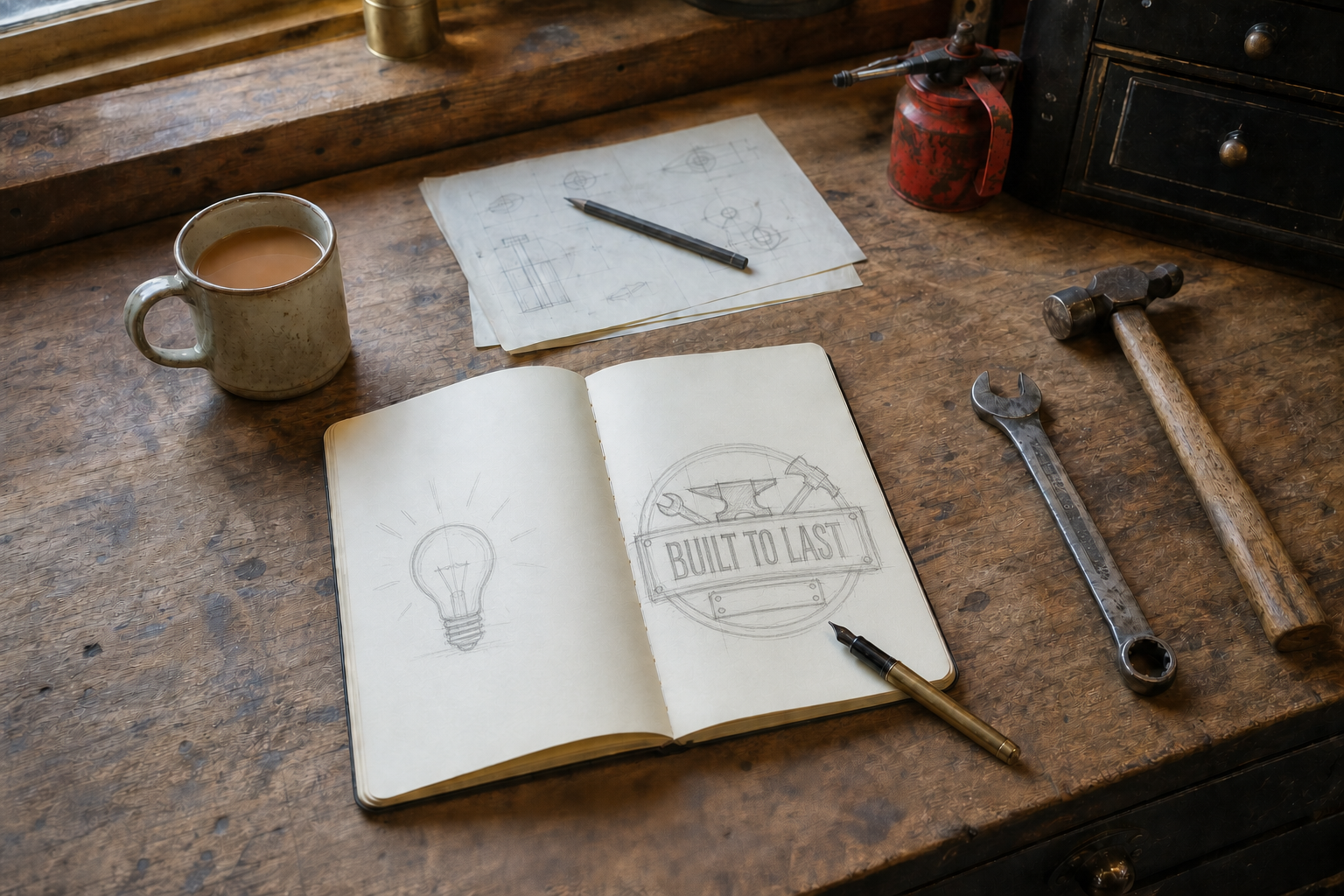
Built to Last. No Warranty. started with curiosity rather than a detailed plan.
I wondered whether I could build a website, how it was actually done and what I might put on it if I managed to get one working. I did not know much about websites when I started, but that was part of the appeal.
I like understanding how things work.
At first, I also had a fairly persistent doubt:
“Is my life really interesting enough for anybody else to want to read about?”
To be honest, part of me still wonders that.
Then I realised that I am rarely sitting still. There always seems to be a job to finish, something to repair, a photograph to take, a dog to walk, a problem to solve or an idea beginning to form.
Perhaps the interesting part is not having an extraordinary life.
Perhaps it is noticing the stories hidden inside an ordinary one.
What began as an inquisitive experiment has gradually turned into a growing hobby. Along the way, it has brought together many of the things I enjoy: engineering, old tools, projects, photography, animals and the jobs that appear straightforward until you actually start them.
There is also a reasonable chance that part of the idea developed while I was searching for a 10mm socket.
I own several of them.
Where they go remains one of engineering’s great unanswered questions.
The website grew from a simple belief that the things which make life interesting are rarely perfect. They have scratches, repairs, stories and the occasional part left over when the job is finished.
I have spent much of my working life around engineering, vehicles, workshops and people who know how to keep things going. That has shaped the way I look at almost everything.
When something breaks, my first thought is usually not:
“Where can I buy another one?”
It is:
“What has gone wrong, and how are we going to fix it?”
Admittedly, this approach has sometimes resulted in a ten-minute job occupying most of a weekend. It has also led to several emergency visits to the tool shop, usually to replace the 10mm socket that I definitely put somewhere safe.
Even so, repairing something brings a satisfaction that replacing it rarely does.
An Engineering Way of Looking at Life
Engineering is not simply what happens in a workshop. After enough years, it becomes a way of thinking.
You listen to the symptoms, identify the fault, consider the available options and decide what to do next.
That is how I tend to approach my health as well.
When a doctor explains a diagnosis, my instinct is not to sit quietly wondering what it all means. I normally listen and then say something along the lines of:
“Okay. Tell me how you’re going to fix it.”
Doctors may use slightly different terminology, but the principle seems perfectly reasonable to me.
Living with Idiopathic Pulmonary Fibrosis, or IPF, and other long-term health conditions cannot be approached in exactly the same way as replacing a worn bearing or repairing a faulty component. People are rather more complicated, and obtaining spare parts is considerably harder.
However, the engineering mindset still helps.
Understand the problem. Listen to people who know more than you. Work with what you have. Adapt the plan when necessary. Keep going.
That does not mean pretending everything is easy. It means concentrating on what can be done rather than spending all your time worrying about what cannot.
A Mind That Does Not Always Switch Off
I have never been particularly good at leaving unfinished things alone.
An incomplete job or a niggling idea has a habit of following me around long after I have put the tools away.
Sometimes I will be lying in bed thinking about a problem I could not solve, a better way of doing something or an idea I do not want to lose before morning.
Sleep and unfinished business do not always coexist peacefully.
That can be frustrating, but it is also part of what keeps me curious. Ideas develop while I am turning them over, and jobs often become clearer once I have stepped away from them.
The sensible thing would probably be to write the idea down and go back to sleep.
I am still working on that.
More Than Old Machinery
Despite the name, this website is not only about old tools, engines or machines.
“Built to last” can describe a well-made spanner, a much-loved vehicle, a dependable friendship, a family tradition or a village shop that has somehow survived every supermarket, online retailer and roadworks diversion thrown at it.
Character matters more than perfection.
Old engineering has plenty of character, but so do people, places, animals and the everyday moments that make life worthwhile.
That is why this journal will wander occasionally.
One article might involve a workshop project or a piece of machinery that refuses to cooperate. The next could be about photography, a walk, a garden job or life with Oliver, my standard poodle, and Flo, my tortoise.
Oliver approaches most activities with enormous enthusiasm, but nothing quite matches his devotion to a tennis ball. Given the opportunity, he would happily run after one all day and still look disappointed when it was time to stop.
Flo takes a more measured approach to life.
Between them, they offer two very different management styles.
Old Ideas and New Ones
I appreciate traditional skills, proper tools and things made to be repaired. However, I do not believe everything old was automatically better.
Some old designs were excellent.
Some were heavy, awkward and apparently created by someone who would never have to service them.
There is much to learn from the past, but new ideas, materials and technology can make life safer, easier and more interesting. The trick is knowing what deserves preserving and what should be improved.
This website itself is an example of that mixture.
Its character comes from old workshops, engineering manuals, worn tools, timber, brass and machines that have earned their scratches. Behind it sits modern technology that allows one person with an idea to create something and share it with people almost anywhere.
Learning to build it has become part of the project.
There have been unfamiliar terms, unexpected problems and moments when changing one small thing has caused something entirely different to move three inches to the left.
In that respect, website building is not entirely unlike working on old machinery.
Learning as We Go
I am not starting this journal because I have all the answers.
Quite the opposite.
I enjoy learning how things work, finding better ways to do them and discovering why the first attempt went wrong. Mistakes will appear here because they are usually the most useful part of any project.
There will be honest reviews, practical lessons and jobs that do not go according to plan. When something fails, I will explain what happened rather than quietly taking photographs from a more flattering angle.
Although I reserve the right to take at least one flattering photograph before admitting defeat.
The aim is to make the site useful without pretending that every reader owns a fully equipped workshop or has forty years of engineering experience.
Some people will arrive knowing exactly which spanner they need.
Others will simply want to understand why their shelf is leaning.
Both are welcome.
Anyone who finds one of my missing 10mm sockets is especially welcome.
Why “No Warranty”?
The second half of the name matters just as much as the first.
Nothing in life comes with a proper warranty.
Plans change. Parts fail. Paint dries in the tin. Weather forecasts become works of fiction. The supposedly universal fitting does not fit anything you own.
We make the best decisions we can, adapt when necessary and keep going.
“No Warranty” is not pessimistic. It is permission to enjoy the process without expecting perfection.
A repair can be worthwhile even if it is not invisible. A project can be successful even when the finished result differs from the original plan. Something can be scratched, patched, modified and still be dependable.
The same is true of people.
What You Will Find Here
This journal will include engineering, workshop projects, repairs, tools, vehicles, photography, gardening, pets and observations from everyday life.
There will be useful information, but also room for humour. The world already contains enough instruction manuals written as though smiling might invalidate the warranty.
Some articles will follow complete projects from the hopeful beginning to the point where I discover that the instructions have omitted an important step.
Others will celebrate things that have lasted: machines, tools, buildings, traditions and people whose quiet reliability deserves recognition.
There will also be photographs simply because something caught my eye.
Not everything needs dismantling to be appreciated.
A Place with Character
I want Built to Last. No Warranty. to feel welcoming.
Not polished until every trace of personality has disappeared. Not full of jargon designed to make simple subjects sound complicated.
Just an honest place to share useful ideas, interesting stories and the occasional avoidable mistake.
You will not need to be an engineer to enjoy it.
Curiosity is enough.
That is how this website began, after all.
Perhaps an article will encourage you to repair something rather than throw it away. Perhaps it will introduce you to an idea you had never considered. Perhaps Oliver will make you smile, or Flo will remind you that not every task needs to be completed before lunch.
And perhaps somebody else who thinks their life is not interesting enough will realise that they have stories worth telling too.
The aim is simple.
Whatever brought you here, I hope you leave a little happier than when you arrived.
One Last Thing…
Things do not need to be perfect to be worth keeping.
Sometimes the scratches are the proof that they have lived.
And if anybody knows where all the 10mm sockets go, please get in touch.
Next in the series
Continue with Building the Journal, Part 2: From Idea to Website, the story of how the idea became a working website.