Building the Journal, Part 2: From Idea to Website
Previously: Building the Journal, Part 1: How It Began
I did not begin this project because I knew how to build a website.
I began because I wondered whether I could.
That is an important distinction.
There was no detailed business plan, no team of designers and no carefully prepared folder marked “Website Strategy”. There was simply an idea, a growing sense of curiosity and the dangerous thought:
“How difficult can it be?”
Anyone who has ever started a supposedly straightforward project will recognise that sentence as an early warning.
Starting with a Name
Before there was a website, there needed to be a name.
I wanted something that reflected the things I enjoy: engineering, old machinery, repairing rather than replacing, learning from mistakes and appreciating objects that have acquired a few scars along the way.
It also needed room for the rest of life.
I did not want a name that limited the site to cars, tools or one type of project. I wanted somewhere I could write about engineering one day, Oliver and Flo the next, then disappear into a garden project, photograph or observation about everyday life.
Eventually, Built to Last. No Warranty. appeared.
It felt right almost immediately.
“Built to Last” represented quality, resilience and the satisfaction of keeping something useful going.
“No Warranty” stopped it from becoming too serious.
It acknowledged that plans go wrong, mistakes happen and very little in life arrives with reliable instructions.
The name also gave the site its personality. It could be practical without becoming dry, thoughtful without becoming gloomy and honest without pretending that every project ends with a professional-looking photograph.
From Name to Identity
Once the name existed, it needed a visual identity.
This was another area where I began with opinions rather than expertise.
I knew what I did not want. I did not want the website to look like a shiny technology company or a corporate brochure. It needed warmth, age and character.
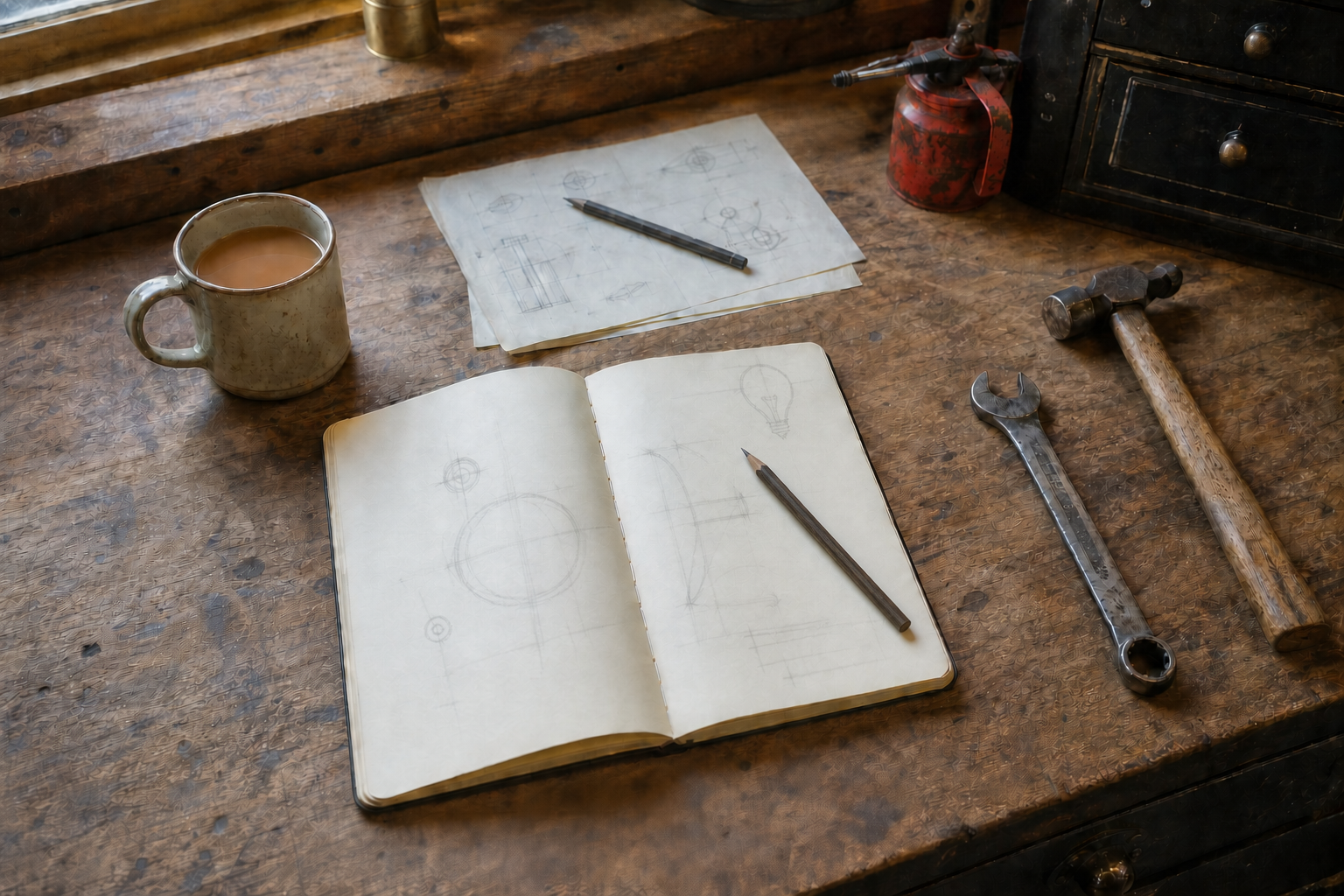
The inspiration came from old workshops, timber, worn tools, brass, machinery and traditional engineering signs. The design needed to feel established without pretending it had existed since 1927.
The logo went through several versions.
Some ideas were too busy. Others lacked personality. Small changes to tools, colours and wording made a surprising difference.
A great deal of this design work happened while I was in bed, late at night, when I was supposed to be sleeping.
At about three o’clock one morning, AI and I were still discussing the logo as though an international engineering standard depended upon it.
On another occasion, a similarly unreasonable amount of time was spent considering fonts and slight variations in colour.
Who knew choosing between two shades that looked almost identical could become such serious work?
That is what happens when an unfinished idea starts niggling at me. Once it has my attention, switching off is not one of my stronger skills.
Eventually, Logo Version 1.0 was agreed and locked.
That process taught me one of the first lessons of building the site: a small detail can occupy an unreasonable amount of time when you care about getting it right.
The same applied to the colours and fonts.
Merriweather was chosen for headings because it has a traditional, readable character. Source Sans 3 was selected for the body text because longer articles still need to be comfortable to read on a phone or computer.
Old and new, working together.
That was becoming a recurring theme.
Buying a Small Piece of the Internet
The next step was securing the domain names.
Buying a domain is a strange moment. Until then, the project is mainly an idea in your head. Once the name belongs to you, the idea suddenly feels more real.
There are also more optional extras than you might expect.
Hosting, privacy, security, renewals and services with reassuring names all appear at once. Some are useful. Others seem designed to make you wonder whether declining them will cause the entire internet to collapse.
The sensible approach was to slow down, check what was actually needed and avoid paying for things simply because a large button recommended them.
That principle has stayed with the project.
Use what is necessary. Understand what it does. Add more only when there is a genuine reason.
Learning WordPress
With the domain and hosting in place, I installed WordPress.
This was the point where curiosity became a proper hobby.
WordPress is powerful, but it introduces itself through a collection of themes, blocks, menus, settings and terminology that assumes you already know which part you need.
At first, even simple questions produced several possible answers.
Should this be a page or a post?
Is the homepage static?
Where has the menu gone?
Why does this look correct on the computer but completely different on the phone?
Most importantly:
What did I just change?
Google and AI quickly became my new best friends.
Without them, none of this would have been possible.
Google helped me find explanations, instructions and other people who had already encountered the same mysterious problem. AI helped me turn questions into plans, understand unfamiliar terminology, organise the project and work through decisions one step at a time.
Many of those conversations took place late at night from bed, while I was supposedly trying to sleep.
One question led to another. A quick idea became a discussion about a logo. The logo led to colours. The colours led to fonts. Before long, it was three o’clock in the morning and I was making decisions about the visual identity of a website that had barely existed a few days earlier.
It probably was not the healthiest sleep routine.
It was, however, surprisingly productive.
Google and AI could not press every button for me or decide what the website should become. That part still needed judgement, patience and the occasional willingness to undo something that had seemed like a good idea ten minutes earlier.
Spelling and grammar checking were just as important. I grew up in Tottenham, North London, and although I always tried my best at school, learning was much harder when a subject did not hold my interest. My handwriting has never done me any favours either. Having tools that can tidy the spelling and grammar without changing what I am trying to say has given me the confidence to turn my thoughts into something other people can comfortably read.
But together, they made it possible for someone who had never built a website to start learning how.
I decided to use the standard WordPress block editor and a straightforward theme rather than installing a complicated page builder. The aim was to keep the site manageable, secure and easy to understand.
That meant learning how the site worked rather than covering it with another system I would also need to learn.
Progress was not always quick, but each step made the next one easier.
A heading appeared in the right font.
A menu began working.
Cards lined up correctly.
Then the mobile view revealed that they had developed ideas of their own.
Website building, I discovered, has much in common with repairing machinery. Changing one part can affect something that appears completely unrelated.
The main difference is that hitting a website with a soft-faced hammer is rarely recommended.
Protecting What Was Already Live
While the real homepage was being developed, a simple public holding page remained in place.
That allowed the website address to exist publicly without exposing unfinished work.
The new homepage was built privately, reviewed privately and kept separate from the live page. This mattered because I did not want visitors arriving halfway through construction to find empty sections, broken links and a note saying:
“Something exciting is coming soon.”
Nothing creates excitement quite like being told to return at an unspecified future date.
Keeping the holding page live also created a useful discipline.
There was no need to rush.
The private homepage could be checked properly on desktop and mobile. Wording could be revised. Colours, spacing and navigation could be reviewed before any decision was made about replacing the public page.
That remains the approach for the whole site.
Draft first. Review carefully. Publish only when it is ready.
Building the Homepage
The homepage needed to explain the website quickly without trying to show everything at once.
The final structure included a Featured Story, the main Journal, Workshop and Life sections, Current Projects, a noticeboard and a simple footer.
Some ideas were deliberately left out.
A website does not need every possible section on its first day. Empty features make a new site feel unfinished, so the aim became to include only what had a clear purpose and genuine content.
The homepage also needed to work on a phone.
That sounds obvious, but a design that looks spacious on a large screen can become a stack of enormous headings, awkward images and mysterious gaps when viewed on something smaller.
Each important section therefore had to be checked in both formats.
The homepage eventually reached Version 1.0 and was approved as a private draft.
The public holding page remained exactly where it was.
That was a satisfying milestone. The site had moved from being an idea, to a name, to a recognisable place with its own character.
It still was not ready to launch.
It needed stories.
Learning Not to Fill Space
One temptation when building a website is to create empty sections simply because other websites have them.
Newsletter.
Archive.
Shop.
Community.
Resources.
Possibly a large button inviting people to join something that does not yet exist.
I decided against that.
Built to Last. No Warranty. should grow because there is something worth adding, not because an empty space needs filling.
Projects that have not started can be marked Planned. Features that are not needed can wait. Articles should come from genuine experiences, useful ideas or stories I actually want to tell.
That makes the site slower to build, but more honest.
There is no point creating a journal about character and authenticity, then filling it with material that exists only to make the homepage look busy.
A Growing Hobby
The website began as an experiment.
Could I build one?
Could I learn enough to make it look and work the way I imagined?
Would I have anything interesting to put on it?
The answer to the first two questions is gradually becoming yes.
The third still crosses my mind.
Then I look at what is happening around me.
There is usually a project underway, a job waiting to be finished, a tool missing, a dog carrying a tennis ball, a tortoise taking a more relaxed view of deadlines or an idea refusing to let me sleep.
There are stories in all of that.
They do not need to be extraordinary.
They simply need to be genuine.
Building the site has become a hobby in its own right. I enjoy learning how it works, solving the problems and watching the separate pieces begin to fit together.
It is not finished.
That is probably part of the appeal.
What Comes Next
The next stage is creating enough genuine content for the site to feel worth visiting.
The Featured Story explains how the idea began. Future articles will cover workshop projects, repairs, tools, pets, photography, gardening and whatever else proves interesting enough to survive the journey from a niggling idea to a finished page.
There will be mistakes.
There will be changes.
There will almost certainly be moments when something that worked perfectly yesterday stops working for no obvious reason.
That is all part of building something from scratch.
The aim is not to create the biggest website or the most polished one.
It is to build a place with character.
Somewhere useful, friendly and honest.
Somewhere that leaves visitors a little happier than when they arrived.
One Last Thing…
You do not always need to know how to do something before you begin.
Sometimes curiosity, Google and a helpful bit of AI are enough to pick up the first tool.
Just try not to make major design decisions at three o’clock in the morning.
Unless, of course, the colour is nearly right.
Next in the series
The next part will tell the story of the real build, the problems we encountered and how we worked through them.