Building the Journal, Part 4: Taking It Into the Real World
Previously: Building the Journal, Part 3: Making Sure It Was Ready
There comes a point in every project when testing it in the workshop is no longer enough.
You can inspect it, measure it, polish it and stand back looking quietly pleased with yourself. Eventually, however, it has to leave the bench and meet the real world.
That was the next stage for Built to Last. No Warranty.
The website had been backed up, checked for security problems and fitted with the essential pages. The contact addresses worked. The domains pointed in the right direction. Privacy, cookies and accessibility had all received more attention than I had originally expected to give them.
On paper, it was ready.
Unfortunately, the real world has never shown much respect for paperwork.
The Difference Between a Test and a Road Test
A website can look perfectly respectable while it is being edited privately.
WordPress provides previews that show approximately how a page or article will appear. These are useful, but they are still only previews.
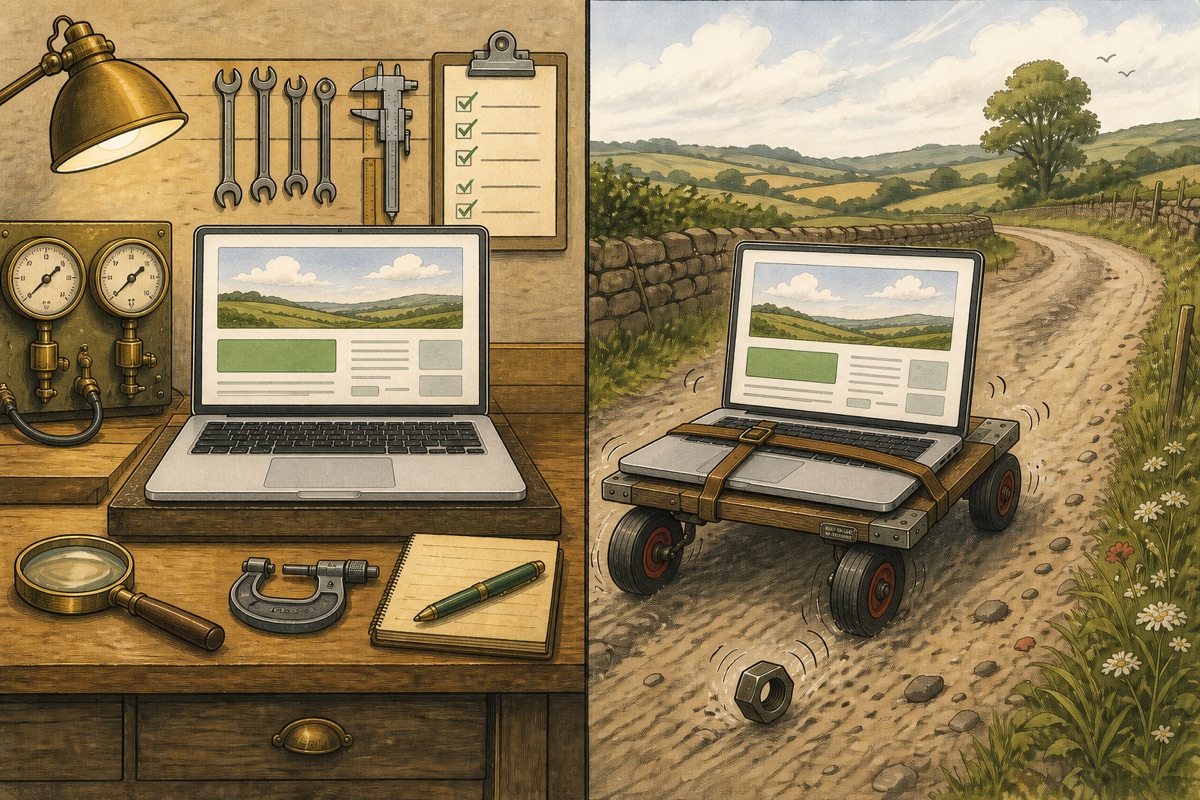
It is a bit like running an engine in the workshop.
You can listen for strange noises, check for leaks and watch the gauges. Everything may appear healthy while the vehicle is sitting still.
The proper test comes when you put it under load, take it onto the road and discover that the mysterious vibration only appears at 53 mph with the heater switched on.
Websites have their own version of this.
An article might look fine in the editor but behave differently once it is publicly available. The live website may use a slightly different layout, apply additional styling or display an image in a way that the preview did not reveal.
In other words, passing the workshop inspection did not automatically provide a fresh MOT.
Back Up, Check and Then Proceed
Before the launch began, another complete backup was created and stored away from the website.
This was not because I expected everything to go wrong.
It was because experience has taught me that machinery can sense confidence.
The moment you say, “That should be fine,” a previously reliable component will often produce a noise last heard from an agricultural implement in 1978.
The same principle applies to websites.
The launch plan was deliberately controlled:
- Make a complete backup.
- Confirm that the holding page remained available.
- Publish one article first.
- Inspect the real public version.
- Test it on a computer and a mobile phone.
- Continue only if everything looked and worked properly.
This was the digital equivalent of tightening the wheel nuts, driving around the block and checking them again before joining the motorway.
One Article, Not the Whole Toolbox
The temptation was to publish everything at once.
Several articles had already been prepared. The homepage was taking shape. The menus, footer and essential pages were in place.
It would have been easy to press a series of buttons and declare the journal launched.
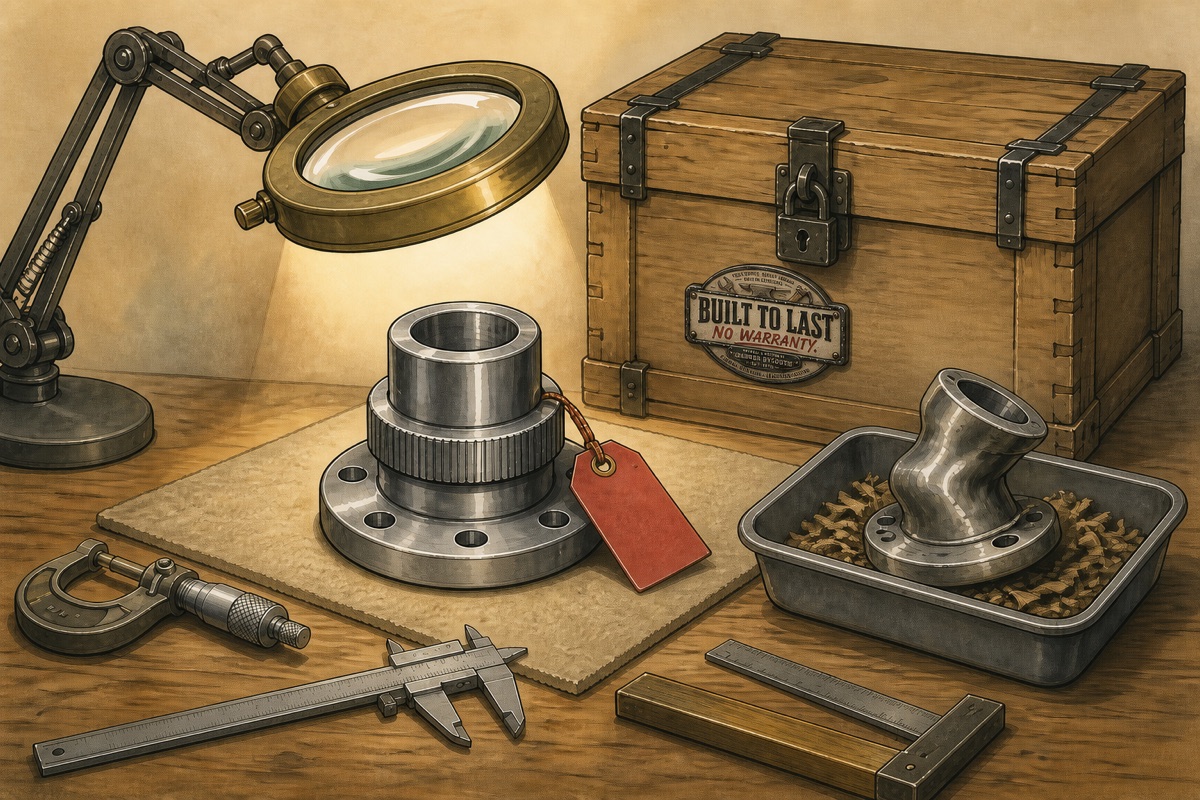
Instead, one article was published as the test piece.
In engineering terms, this was the prototype.
You do not manufacture fifty components before checking whether the first one fits. At least, you should not. If you do, you have not created a production run. You have created a matching set of expensive mistakes.
Publishing a single article meant the live website could be inspected without committing everything else.
That decision proved useful almost immediately.
The First Real-World Fault
The article had looked acceptable in preview.
Once it was publicly visible, it became clear that the live article template was not behaving as intended.
The header looked too plain. The featured image was oversized and competed with the title. Parts of the layout overlapped, and some footer links had wandered away from their proper positions.
Nothing was technically broken in the dramatic sense. The website had not burst into flames, thrown a connecting rod through the bonnet or started emailing strangers by itself.
It simply did not look right.
That mattered.
A website can function correctly and still give visitors the impression that somebody assembled it shortly before closing time on a Friday.
The fault was not with the article itself. It was in the template that WordPress used to display public articles.
A template is the basic layout that controls where common parts of a page appear. It tells the website where to place the title, photograph, article text, categories and footer.
Think of it as a jig in a workshop.
The individual article provides the material, but the jig determines how everything is positioned. If the jig is wrong, every item made with it will carry the same fault.
Publishing more articles would simply have repeated the problem.
Knowing When to Stop
The launch was halted.
The test article was returned to draft, which made it unavailable to ordinary visitors again. The original holding page stayed in place, and the remaining articles were left unpublished.
That was not a failed launch.
It was the launch procedure doing exactly what it was meant to do.
A proper test is not designed to produce a pass. It is designed to reveal the truth.
If an inspection finds a fault, the correct response is not to move the clipboard slightly so you can no longer see it.
There is an important engineering habit behind this:
When a test produces an unexpected result, stop and understand it before continuing.
Carrying on simply because the launch had started would have turned one manageable problem into several public ones.
Besides, there are few situations improved by the phrase, “It was making that noise earlier, but I thought I’d see what happened.”
Repairing the Cause

The problem was corrected with carefully targeted styling changes.
In plain English, the website was given clearer instructions about how articles and photographs should be displayed.
The objective was not to redesign everything. It was to correct the faulty areas while leaving the parts that already worked alone.
This is similar to repairing a machine.
If one bearing has failed, you do not immediately replace the gearbox, repaint the chassis and fit a new horn. You identify the failed component, confirm the cause and make the smallest reliable repair.
The article header was improved. Featured images were given more sensible proportions. Footer wording and links were returned to the centre, where they belonged.
A portrait photograph of Oliver provided a particularly useful test.
The website had tried to force the image into an unsuitable wide shape. Oliver is many things, but panoramic is not one of them.
The image was corrected so that it retained its natural portrait proportions on both a computer and a phone.
Oliver remained recognisably a Standard Poodle rather than becoming a furry landscape feature.
Testing the Repair Properly
After the changes were made, the public pages were checked again.
This included an ordinary desktop display and a mobile screen measuring 390 by 844 pixels.
That exact number may sound unnecessarily precise, but screen size matters. A layout that works on a large monitor can behave very differently when squeezed onto a phone.
It is similar to checking clearances throughout the full movement of a mechanical assembly.
A component might fit perfectly while everything is stationary, then catch when the suspension compresses or the steering reaches full lock.
For the website, the checks included:
- The article title remained readable.
- The featured photograph kept the correct proportions.
- Images did not overlap the text.
- Footer wording remained centred.
- Links stayed in their correct positions.
- Nothing created sideways scrolling.
- The layout remained usable on a phone.
Only after those checks passed was the repaired presentation accepted.
The website had completed its road test without leaving any components behind.
Telling Search Engines Where to Look
Once a website is public, there is another audience to consider: search engines.
Google does not instantly know that a new journal exists. Nor does it send somebody round with a clipboard and a welcome pack.
The website provides a file called a sitemap.
Despite the name, this is not a map showing where the workshop, kettle and emergency biscuit supply are located.
A sitemap is more like a contents list. It tells search engines which public pages and articles exist and where they can be found.
The sitemap was submitted through Google Search Console.
Google Search Console is a free service that allows a website owner to see whether Google can find and understand the site. It can report missing pages, indexing problems and other technical issues.
Submitting a sitemap does not guarantee instant visitors or a position at the top of Google.
It is more like notifying the DVLA that a vehicle exists. It puts the correct information into the system, but it does not arrange a cheering crowd at the end of the driveway.
The sitemap was accepted successfully, and Google began processing the website’s pages.
That was enough.
There was no need to keep pressing Submit in the hope that enthusiasm might improve the result.
A Quiet Launch
There was no launch party.
No countdown clock.
No ribbon was cut, and nobody smashed a bottle of champagne against the MacBook.
The journal simply became available.
That felt appropriate.
Built to Last. No Warranty. was never intended to arrive with a lot of noise and make promises it could not keep. It was built to grow gradually through genuine stories, practical projects, photographs and lessons learnt along the way.
The first public articles gave the website something more important than a technical structure.
They gave it a voice.
Until then, the journal had mainly consisted of plans, menus, settings, plugins and private drafts. Publishing transformed it from something being constructed into something that could be read.
It had entered the real world.
What the Launch Taught Me
The most useful lesson was that private testing and public testing are not the same thing.
Previews are valuable, but they cannot reproduce every part of the live experience.
That is why a controlled launch mattered.
Publishing one article first exposed a problem without spreading it across the entire journal. Stopping gave us time to diagnose the cause. Repairing the template corrected future articles as well as the test page. Checking desktop and mobile layouts confirmed that the repair worked under different conditions.
The process followed familiar engineering principles:
- Protect what already exists.
- Test one item before repeating it.
- Inspect the result under real conditions.
- Stop when something unexpected happens.
- Repair the cause rather than hiding the symptom.
- Repeat the original test.
- Record what was learnt.
The tools were different, but the thinking was much the same.
A spanner was replaced by a browser, the workshop manual became online documentation, and the oil stains were considerably easier to remove.
From Website Project to Public Journal
Taking the website into the real world changed the nature of the project.
It was no longer enough for me to understand how everything worked. Visitors needed to find their way around, read comfortably and trust that the website had been put together with care.
That did not mean it had to be perfect.
Perfection would have delayed the launch indefinitely and made the name rather difficult to defend.
It needed to be safe, readable, honest and ready to improve.
That was the standard.
The journal was online. The first faults had been found and corrected. Search engines had been shown the front door, and the website had survived contact with the public internet.
Nothing had fallen off.
For a first road test, that seemed a perfectly respectable result.
A Small but Proper Hurrah
I had started with little more than an idea and a determination to understand how websites worked.
Now I had built one.
It had its own name, identity, articles, photographs, contact addresses, security, backups and a place on the public internet. I had learnt an enormous amount, solved several unexpected problems and resisted the occasional temptation to test the MacBook’s ability to fly.
There was still plenty to do, but that did not take anything away from what had already been achieved.
I was proud of it.
Not in a loud, champagne-across-the-bonnet sort of way. More the quiet satisfaction of standing back from a finished job, wiping your hands on a workshop cloth and thinking:
That actually works. And I built it.
Built to Last. No Warranty. was live.
So, just this once, the workshop could permit a small celebration.
Hurrah!
No brass band. No fireworks. Just a raised mug of tea, a slightly surprised smile and the reassuring knowledge that, so far, nothing important had fallen off.
Workshop status: Road tested, officially live and released into the wild. Owner quietly delighted. Minor adjustments expected. Toolkit remains in the boot.
Continue the story
Previous: Building the Journal, Part 3: Making Sure It Was Ready.
Where next?
The story of building the journal pauses here for now, but there is plenty more to explore.
If you fancy something practical, continue with The Garden Table Workshop. Or, for tennis balls, tortoise-paced deadlines and two very different approaches to life, meet Oliver and Flo.
You can also browse all Journal entries and choose your own route through the workshop.