From a Light Aid Detachment to Le Mans: Ken Miles, REME and the Ford GT40
Long before Ken Miles helped turn the Ford GT40 into a Le Mans winner, he had worked in Army workshops and served in a Light Aid Detachment. That may not be the glamorous part of his story, but it could be the part that explains everything else.
Miles is usually remembered as a racing driver. He was also a mechanic, engineer and development driver who understood that a fast machine is only useful when the people around it can diagnose, improve and trust it.
Before the GT40
The REME Museum’s research places Miles among the founder members of the Corps. His service record shows that he joined Training Establishment REME on 1 October 1942, before postings to Guards Armoured Troops Workshops and 29 Armoured Brigade Workshop.
He left the United Kingdom for Normandy in June 1944 and later served with the 15th/19th King’s Royal Hussars Light Aid Detachment. His recorded trade was Armament Artificer. He was discharged to the reserves in April 1946.
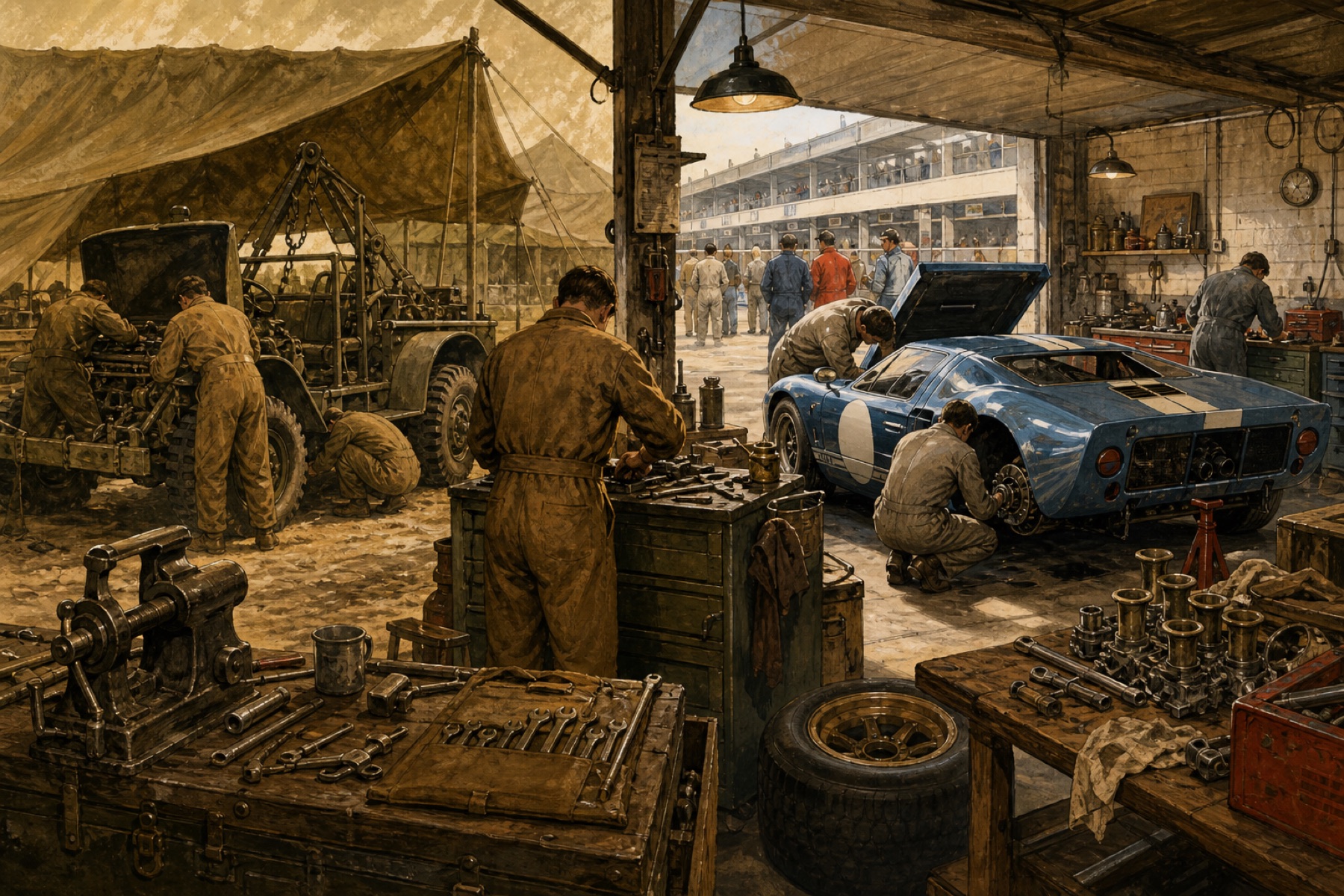
For readers outside the Army, a Light Aid Detachment, usually shortened to LAD, is a small REME workshop team attached to a military unit to provide close repair support.
That matters because a Light Aid Detachment was not a comfortable workshop waiting for jobs to arrive. Its purpose was to support a unit close to where its vehicles and equipment were working. Fault-finding, improvisation and sound judgement were not optional extras. The right repair had to be made with the time, tools and parts available.
A driver who listened to the machine
After the war, Miles built and raced cars before moving to the United States in 1952. He competed successfully and eventually became competition director and test driver for Shelby American. His value was not simply that he could drive quickly. He could return from a test and explain what the car was doing, why it was doing it and what might make it better.
That link between the driver’s seat and the workshop floor is easy to underestimate. A machine may behave perfectly on paper and quite differently when heat, vibration, fatigue and human judgement enter the picture. A good development driver does more than report a problem. He helps turn a feeling into useful engineering information.
The Ford GT40 and 1966
Miles and Lloyd Ruby won the 24 Hours of Daytona in a Ford GT40 Mk II in 1966. Miles then won the 12 Hours of Sebring with Ruby before arriving at Le Mans with the possibility of an extraordinary endurance-racing treble.
Ford achieved its famous first, second and third-place finish at Le Mans that year. The carefully arranged finish meant that Bruce McLaren and Chris Amon were declared the winners, while Miles and Denny Hulme were classified second. The result has been debated ever since, but it should not obscure Miles’s contribution to developing the car that made Ford’s success possible.
Ford went on to win Le Mans four years in succession from 1966 to 1969. The headline belongs to the victories, but the lasting lesson is the amount of testing, repair, feedback and persistence required before a difficult machine becomes a dependable one.
History rather than Hollywood
The film Ford v Ferrari introduced Miles to a much wider audience, but a film needs a clear story and memorable scenes. The REME Museum has checked the real service record and points out that some of the film’s wartime claims do not fit the evidence.
The verified history is interesting enough. Miles was an Armament Artificer who served in workshops and an LAD, then carried that practical understanding into motor racing and vehicle development. There is no need to improve the story with a legend.
Why his story belongs in the Workshop
I have no personal connection to Ken Miles or the GT40, and this is not my project. My own connection comes through working for the Ministry of Defence as a civilian supporting the British Army. I have worked in an LAD and now, still as a civilian, hold the O/C, or Officer Commanding, role for three LADs. That experience means I recognise the mentality behind the story: listen carefully, understand the fault, explain it plainly and keep the machine moving.
Being able to drive something and being able to understand it are not the same skill. Miles could do both. That combination helped make him one of the most important development drivers in Ford’s racing history, even if the result beside his name at Le Mans does not tell the whole story.